Developing Career Options for Data Stewards – A Report from the London Open Science and Scholarship Festival 2026
How do we develop career options for Data Stewards? In April 2026, STEP-UP working with CaSDaR, the Research Data Alliance (RDA) Data Steward Career Tracks Working Group, and, of course, the London Open Science and Scholarship Festival ran a workshop for Data Stewards to discuss current challenges and start to develop a community vision for a solution. This blog post by James Wilson (University College London) summarises the discussions.
In what may be a record for a half-day workshop, on the 22nd April, 2026, we ran an event jointly organized by no fewer than 4 different project and organizational teams: STEP-UP, CaSDaR, the RDA Data Steward Career Tracks Working Group, and, of course, the London Open Science and Scholarship Festival itself. The teams had come together to organize and run a ‘Developing Career Options for Data Stewards’ event. As (bad) luck would have it, the morning we had selected for the workshop turned out to coincide with a Tube strike. This did at least have the effect of making the decision to run the workshop in a hybrid format look far-sighted, rather than a recipe for trouble. That was until we launched the meeting over Zoom, only to realize that when we had been informed that UCL’s sparkling new ‘Yellow Room’ was Teams-enabled, and only Teams-enabled, they really weren’t just being over-cautious. No matter, we battled through adversity and problematic audio with a combined attendance of about fifty and managed to stage an informative session.
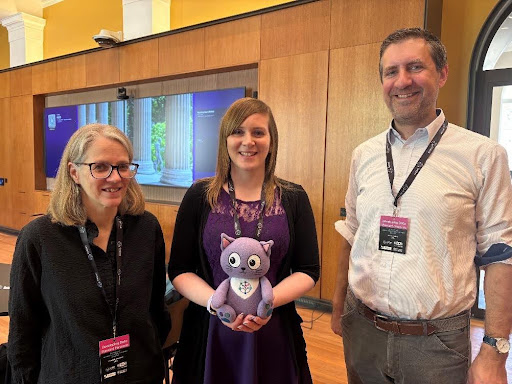
Image Left to right: Elizabeth Newbold (STFC & RDA Data Steward Career Tracks WG), Sami Pearman-Kanza (University of Southampton & CaSDaR), James A J Wilson (UCL & STEP-UP), plus Cassie the CaSDaR mascot.
After introducing the various groups with an interest in career structures for Research Data Stewards, the workshop began with a short history of Data Stewardship as a term, and a discussion about what it meant to the attendees. Whilst 71% of our attendees said that they performed the functions of a data steward (13% did not, and, tellingly, 16% were unsure), only a third reported that their job description explicitly mentioned or referred to ‘data stewardship’ or used the term ‘data steward’ – and this was probably skewed by a good attendance from the local UCL Advanced Research Computing (ARC) team. It seems that the term has not yet caught on all that widely, and research data stewards may not be aware that they are research data stewards for some time yet.
Asked what ‘data stewardship or being a data steward mean[s] to you’, resulted in a range of responses. These clustered around the FAIR principles, data life-cycle management, caring for and curating data, and ensuring data quality.
One of the elements of data stewardship that we were most interested in from the STEP-UP perspective was the challenge of developing career pathways. in data stewardship. Issues raised that were relevant to this included:
- Not knowing where to get training, and the absence of clear training pathways
- Getting buy-in from researchers, institutions, and publishers
- Researchers not understanding how much effort good data management requires, and consequently not costing this work into research grants
- The lack of obvious job transferability between institutions
- Data stewards being neither quite researchers nor professional services staff, but rather ‘living in a no man’s land between’
- A general lack of professional recognition of data stewardship
- A lack of defined qualifications
- The absence of a formal agreement as to what exactly a Research Data Steward is or does
- The lack of a clear career path or a promotion structure (which at least confirmed the relevance of the work STEP-UP is undertaking)
- The challenge of covering a range of disciplines
- A lack of technical knowledge
- A lack of national and international benchmarks
- Unclear reward and recognition structures
- And, of course, ‘AI’ – and what its impact might be on the fledgling profession
When asked specifically about the key skills and competencies required to be an effective data steward, many of the responses focused either on technical skills or people skills. Being able to understand the needs of researchers and communicate concepts such as the FAIR principles were considered vital, as was an understanding of documentation and metadata, machine readability, and knowledge of data policies and governance. In terms of technical knowledge, general IT skills were considered useful, as was a grasp of databases and spreadsheets, coding, and semantics. More general skills and competencies included an attention to detail, problem solving, critical thinking, and an ability to work collaboratively. Some attendees suggested that being a bit of a data ‘geek’ or ‘nerd’ was a definite plus.
Matching some of the STEP-UP training findings, more senior Research Data Stewards or their managers were deemed to need general skills such as leadership, confidence when communicating, good organizational skills, good networking skills, and knowing one’s research field. Strong experience at a more junior level was also mentioned.
Conclusions
One thing that became obvious from the workshop, and indeed its organization, was how many different groups, organizations, and projects currently have a stake in the development of professional data stewards in particular, and digital research technology professionals more broadly. One of the challenges that we need to address as a community, is ensuring that we minimize the re-invention of wheels, and collaboratively learn what will be needed to transform data stewardship into a recognized and well-supported profession that can bring genuine benefits to researchers, and indeed research, enabling the re-use and re-combination of data to enable innovation and a better understanding of the world.